Buon Anniversario Vespa!
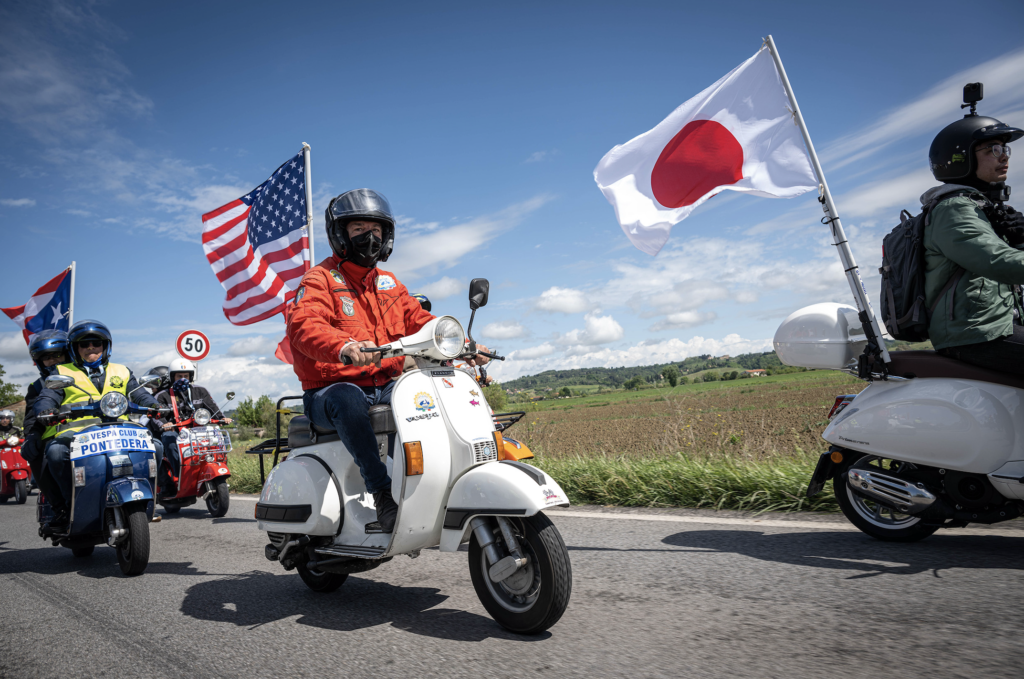
On April 23, 1946, Vespa registered its patent for the quintessential scooter and in the intervening 80 years nearly 20 million vehicles have joined the party! Today, Vespa is a global brand, manufactured at three sites: Pontedera, the plant where Vespa production has continued uninterrupted since 1946, for the European and Western markets, including the Americas; Vinh Phuc, in Vietnam, which serves the local market and the Far East; and India, at the ultra-modern Baramati factory, opened in April 2012 to produce Vespas for the Indian market.
In the past decade alone, more than 2 million new Vespas have been produced and ridden on roads all over the world. Since 2004, when 58,000 vehicles were produced, the growth of the Vespa brand has been constant and spectacular. More than 100,000 units were produced in 2006, 180,000 in 2017, and the milestone of 200,000 units per year was surpassed in 2018.
Blast From The Past
Vespa (which means “wasp” in Italian) was the result of Enrico Piaggio’s determination to create a post-war low-cost product for the masses. As the end of WWII drew near, Enrico studied every solution possible to relaunch production in his plants, beginning with the one in Biella, where a “motor scooter” was created using the small motorcycle models used by parachutists as a starting point.
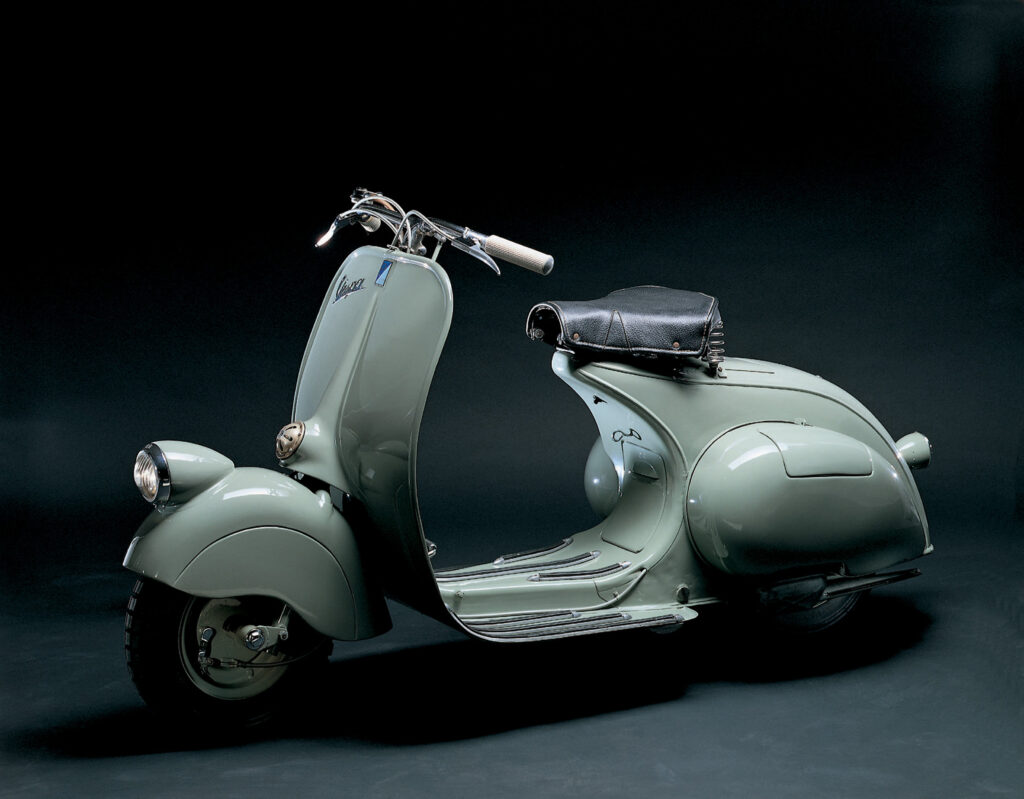
The prototype, known as MP5, was nicknamed “Paperino” (the Italian name for Donald Duck) due to its strange shape, but Enrico Piaggio did not like it, and he asked aeronautical engineer Corradino D’Ascanio to redesign it. D’Ascanio didn’t like motorcycles, which he considered to be uncomfortable and bulky with tires that were too hard to change, as well as being dirty due to the drive chain. Taking cues from aviation, found a solution to every problem by eliminating the chain, changing from a frame to a load-bearing body; and swapping a CVT constant mesh gearbox; to make it easier to ride. He also put the shifter on the handlebar; designed a supporting arm similar to an aircraft carriage instead of a fork..
With the help of Mario D’Este, his trusted designer, it would only take Corradino D’Ascanio a few days to fine tune his idea and prepare the first Vespa design; production was launched in Pontedera in April of 1946. Enrico Piaggio himself named the scooter after standing in front of the MP6 prototype, with its narrow waist, he exclaimed: “It looks like a wasp!” And so, the Vespa was born.